What is Reservation Hatao Andolan? A Complete Explainer
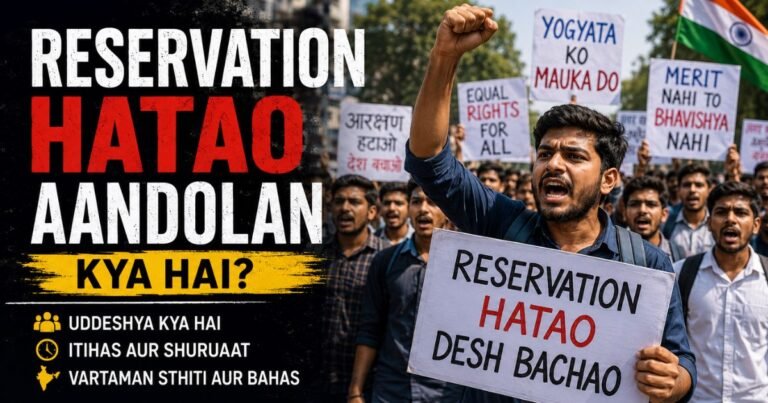
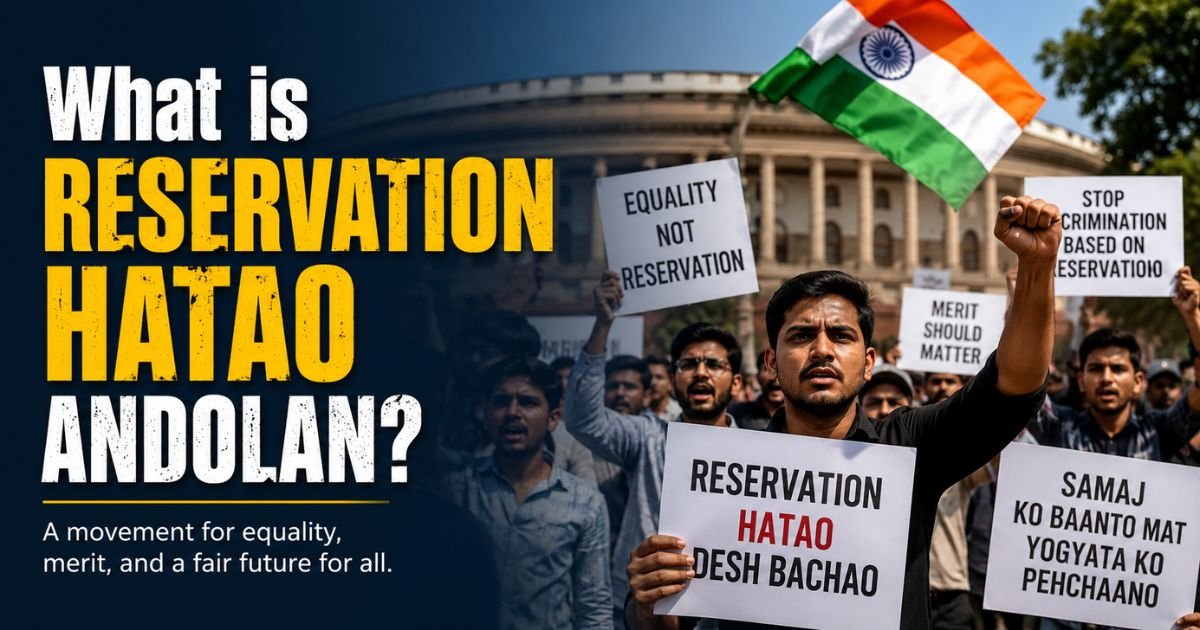
In late July 2026, a new phrase began spreading rapidly across Indian social media: Reservation Hatao Andolan. Within hours of its Instagram page going live, the account crossed one million followers. By the next day, reports put the count even higher.
Young people, mostly from the general category and Gen Z, started sharing posts calling for the removal of caste-based reservations in education and government jobs. The timing was striking. It emerged right after the Cockroach Janta Party (CJP) protests forced the resignation of the Union Education Minister over repeated exam paper leaks.
Many Indians, especially students preparing for competitive exams, have long felt the weight of reservation policies. Cut-offs for general category seats in medical and engineering colleges often sit far higher than those for reserved categories.
At the same time, supporters of the existing system argue that caste discrimination has not disappeared and that reservations remain necessary for social justice.
This article explains exactly what the Reservation Hatao Andolan is, how it started, what its supporters want, and the larger debate it has reopened.
Quick Answer
Reservation Hatao Andolan is a citizen-led, mostly online movement that began in July 2026. It demands the end of caste-based reservations in education and government jobs. Supporters want selection based on merit, skills, and economic need instead of caste. The campaign gained millions of Instagram followers within a day of launch, following the CJP student protests.
What is Reservation Hatao Andolan?
Reservation Hatao Andolan, often shortened to RHA, is a youth-driven campaign that calls for the removal of caste-based reservation in India. The Hindi words translate simply: “Reservation” means the quota system, “Hatao” means remove, and “Andolan” means movement or agitation.
The movement is not registered as a political party. Its Instagram page and related posts describe it as a citizen-led effort. Organizers say they once hoped a change in government would reform the system. When they felt that did not happen, they decided the issue should sit outside party politics.
Core messaging focuses on three ideas: equality of opportunity, selection by merit, and the gradual removal of caste as a public identity marker. Posts frequently use slogans such as “Equality. Merit. Justice.” and “One Nation, One Identity – Indian.”
The campaign argues that if the long-term goal is to eliminate caste discrimination, the government should stop requiring people to declare their caste on forms for school admissions, college seats, and government jobs. Supporters say this practice itself keeps caste alive in daily life.
How Did the Reservation Hatao Andolan Begin?
The movement did not appear in isolation. It followed the large student protests led by the Cockroach Janta Party in June and July 2026.
CJP began as a satirical online response to a comment by the Chief Justice of India that referred to certain unemployed youth as “cockroaches.” The group later shifted focus to repeated leaks in major entrance exams, especially NEET. Protests at Jantar Mantar and elsewhere grew. On 25 July 2026 the Union Education Minister resigned. The CJP then called off its agitation.
Within a day, the Reservation Hatao Andolan Instagram page appeared and began growing at an extraordinary rate. Some reports said it moved from under 100,000 to over one million followers in a few hours. Other posts claimed figures above two million shortly afterward.
The connection is clear in the timing and the shared audience of frustrated students. Many young people who joined CJP protests over exam integrity also felt that the reservation system creates unequal starting lines. The new campaign gave that frustration a different focus.
Key Demands of the Reservation Hatao Andolan
Public posts and statements associated with the movement list several consistent demands:
- End caste-based quotas in educational institutions and government jobs.
- Shift to selection based on merit, skills, and economic need.
- Stop the routine requirement to declare caste on official forms and applications.
- Move toward an economic-criteria system that helps genuinely poor students and families regardless of caste.
- Create a society where caste identity is no longer an official category in public administration.
Some supporters, including voices outside the page itself such as activist Anuradha Tiwari, have suggested additional practical reforms. These include limiting benefits to one generation or one family member, introducing a sunset clause that phases out quotas after a fixed period, and stronger enforcement of the creamy-layer exclusion.
The movement presents itself as peaceful and civic. Posts have shown symbolic gestures meant to reject caste hierarchy, such as people from different caste backgrounds sharing the same water bottle. Organizers have also spoken of planned peaceful protests.
Understanding India’s Reservation System
To understand the Andolan, one must first understand the system it wants to change.
India’s reservation policy reserves a fixed percentage of seats in government educational institutions and government jobs for certain social groups. The policy rests on the idea that historical discrimination created deep disadvantages that pure open competition would not correct quickly enough.
Current Reservation Quotas at the Central Level
As of 2026 the central government applies these percentages in most of its institutions:
| Category | Percentage |
|---|---|
| Scheduled Castes (SC) | 15% |
| Scheduled Tribes (ST) | 7.5% |
| Other Backward Classes (OBC) | 27% |
| Economically Weaker Sections (EWS) | 10% |
| Total | 59.5% |
Horizontal reservations also exist for persons with disabilities (usually 4%) and, in some places, for women or ex-servicemen.
States can and do set higher totals. Tamil Nadu maintains 69%. Some northeastern states reserve the majority of seats for local Scheduled Tribes.
The remaining open seats form the general or unreserved category. Candidates from reserved categories can also compete for these open seats if their scores are high enough.
Constitutional Basis
Articles 15(4) and 16(4) of the Constitution allow the state to make special provisions for the advancement of socially and educationally backward classes and for adequate representation in public employment. Article 46 directs the state to promote the educational and economic interests of the weaker sections, especially SCs and STs.
The 103rd Constitutional Amendment in 2019 added the 10% EWS quota for economically weaker sections among those not covered by existing caste quotas. The Supreme Court upheld this amendment in 2022.
A Brief History of Reservations in India
Reservation did not begin in 1950.
In 1902 the Maharaja of Kolhapur introduced quotas in education for non-Brahmin communities. Mysore followed in 1918. The Justice Party in Madras issued the first major communal government order in 1921.
The Poona Pact of 1932 between Mahatma Gandhi and B.R. Ambedkar settled the question of separate electorates by creating reserved seats for depressed classes within the Hindu electorate.
After independence the Constitution provided for SC and ST reservations. The Mandal Commission, set up in 1979, recommended 27% reservation for Other Backward Classes.
The V.P. Singh government implemented this for central government jobs in 1990. The same quota was extended to higher education in 2006.
The 10% EWS quota arrived in 2019. In August 2024 the Supreme Court allowed states to create sub-quotas within SC and ST categories.
Previous Anti-Reservation Movements in India
Opposition to expanding quotas is not new.
In 1990 the implementation of the Mandal Commission recommendations triggered large protests across northern India. Students from the general category staged marches, and several cases of self-immolation occurred. The most remembered was that of Rajiv Goswami outside AIIMS in Delhi.
In 2006 the decision to extend OBC reservation to central educational institutions sparked another wave of protests. Medical students and doctors formed the Youth for Equality group. They demanded a rollback of the new quota and a white paper on the entire reservation policy.
Other communities have agitated in the opposite direction, seeking inclusion in the reserved lists. Gujjars, Jats, Patidars, and Marathas have all demanded OBC or ST status at different times, sometimes leading to violence.
The 2026 Reservation Hatao Andolan is the first major digital-native, Gen-Z-led campaign focused primarily on reducing or ending caste quotas rather than expanding them.
Why Supporters Back Reservation Hatao Andolan
Supporters raise several practical and philosophical points.
First, they argue that after more than seventy years the system has not ended caste consciousness. Instead, it has made caste a permanent official category that every student and job applicant must declare.
Second, they point to the large difference in cut-off marks. In many medical and engineering entrance exams, the general category cut-off is significantly higher than the reserved category cut-off. Students who score higher sometimes lose seats to those with lower scores solely because of category.
Third, they note that the benefits often reach the “creamy layer” – families that are already well-off within the reserved categories – while the poorest in every community remain left out.
Fourth, they believe a pure economic criterion would help poor students from every background and reduce the social tension that caste quotas create.
Fifth, many young people feel the current system damages the idea of equal citizenship. They want a country where a person’s opportunities do not depend on the accident of birth into a particular caste.
Why Critics Oppose Ending Reservations
Critics of the Andolan and of any rapid dismantling of quotas make equally strong arguments.
They say caste discrimination still exists in marriage, housing, villages, and everyday social interactions. Removing reservations before social attitudes change would leave historically disadvantaged groups without a tool to gain education and government jobs.
They point out that representation in higher education and the higher bureaucracy remains uneven. Without quotas, the share of SC, ST, and OBC candidates in premier institutions would drop sharply.
They argue that the Constitution itself treats social and educational backwardness as a legitimate ground for special measures. Pure economic criteria, they say, would miss the social barriers that continue to operate.
They also note that several people from reserved categories now hold high constitutional offices. This, they claim, shows the system has worked in creating a broader elite. Ending it abruptly would reverse those gains.
Finally, critics worry that an anti-reservation movement could itself become a vehicle for upper-caste assertion and deepen social polarisation.
The Creamy Layer Debate and Reform Ideas
Even many supporters of the existing system agree that the “creamy layer” problem is real.
The Supreme Court introduced the creamy-layer concept for OBCs in the 1992 Indra Sawhney judgment. Children of high-ranking officials, professionals, and families above a certain income limit are excluded from OBC benefits. The current income ceiling stands at ₹8 lakh per year, though some bodies have recommended raising it.
In 2024 the Supreme Court suggested that a similar exclusion should eventually apply to SC and ST categories as well.
Reform proposals that appear in public debate include:
- Strict one-time use of reservation benefits per family.
- A clear sunset clause after a fixed number of years.
- Better data collection through a comprehensive caste census followed by evidence-based sub-quotas.
- Stronger focus on primary and secondary education quality so that more students from all backgrounds can compete on open merit.
The Reservation Hatao Andolan itself leans toward complete removal rather than gradual reform, but many of its supporters accept that a sudden overnight change is neither practical nor desirable.
Impact of Reservations on Education and Employment
In competitive exams the effect is visible every year. General category students often need substantially higher marks to secure the same seat that a reserved category student can obtain with lower marks. This creates deep frustration among high-scoring general category candidates and their families.
At the same time, data over decades shows that the absolute number of SC, ST, and OBC students in higher education has risen. Representation in government jobs has also improved compared with the pre-independence period.
Private sector jobs remain largely free of formal caste quotas, which is why many general category students are advised to look there. However, government jobs still carry prestige, security, and influence in large parts of the country.
The 10% EWS quota was meant to address economic disadvantage among the general category. Its implementation has been uneven, and income verification remains a practical challenge.
What Experts and the Public Are Saying
Public reaction has been sharply divided. On social media the Andolan posts receive strong support from many general category youth. At the same time, reserved category students and activists have posted counter-arguments emphasising continued social discrimination.
Political parties have so far stayed cautious. No major party has officially endorsed the complete removal of caste reservations. Commentators note that the issue remains highly sensitive and that any sudden policy shift would face legal challenges under the Constitution.
Some independent voices suggest a middle path: retain limited reservation for a defined period, apply creamy-layer rules strictly across all categories, improve school education, and gradually shift the weight of affirmative action toward economic criteria.
Possible Way Forward
The Reservation Hatao Andolan is still very new. Whether it remains an online campaign or grows into sustained street action is not yet clear.
Any lasting change would require constitutional amendments, new legislation, and likely multiple rounds of Supreme Court scrutiny. The 50% ceiling that the Court once treated as a general rule has already been breached by the EWS quota and by several state policies. Further changes would face the same legal tests of reasonableness and equality.
In the short term the movement has succeeded in one clear way: it has forced a fresh national conversation about whether the current form of reservation still serves its original purpose after seven decades.
FAQs About What is Reservation Hatao Andolan
What is the difference between Reservation Hatao Andolan and earlier anti-reservation protests?
Earlier protests in 1990 and 2006 were largely physical student movements against specific expansions of quotas. The 2026 Andolan is digital-first, Gen-Z driven, and calls for the broader removal of caste as a criterion rather than just opposing one new quota.
Is Reservation Hatao Andolan linked to any political party?
Public statements from the campaign say it is not affiliated with any political party. It presents itself as a citizen initiative that deliberately stays outside party politics.
Can caste-based reservation be removed overnight?
No. The policy is embedded in the Constitution and in multiple Supreme Court judgments. Removing or fundamentally altering it would require legislative and constitutional processes that take time and face judicial review.
What is the creamy layer and why does it matter?
The creamy layer refers to the relatively better-off section within a reserved category. The idea is that families that have already gained education, income, and status should not continue to claim the same benefits meant for the most disadvantaged. Strict application of this principle is one of the most discussed reform ideas.
Conclusion
Reservation Hatao Andolan is the latest expression of a long-running tension in Indian society. On one side stands the constitutional commitment to correct historical injustice through special measures. On the other stands the demand that individual merit and equal citizenship should not be permanently subordinated to group identity.
The movement has succeeded in bringing the debate back into the open with remarkable speed. Whether it produces lasting policy change remains to be seen. What is already clear is that a large section of young Indians feels the current system no longer matches the India they want to live in.
Any honest discussion must hold two truths at once: caste discrimination has not fully disappeared, and a system designed as a temporary corrective can, over time, create new forms of unfairness and social friction. Finding a path that reduces both problems is the real challenge ahead.
Disclaimer: This article is for informational purposes only. It explains a current social and political debate based on publicly available information as of July 2026. It does not take a political position or offer legal advice. Readers should consult official government sources and court judgments for the latest policy details.